
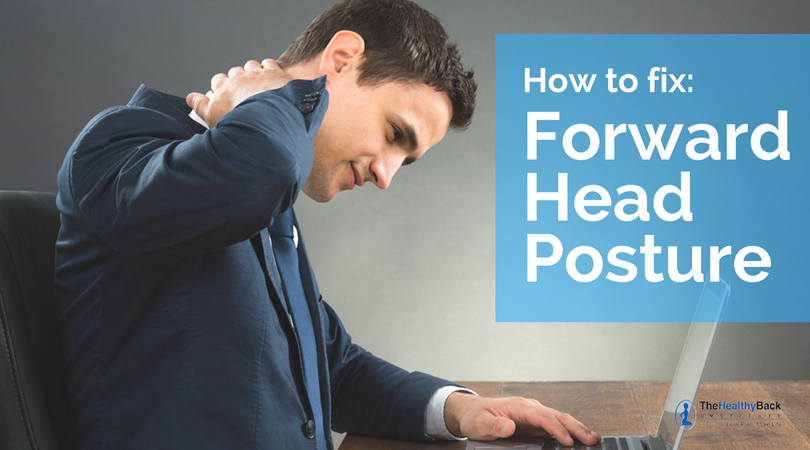
Do you suffer from neck pain, shoulder pain or upper back pain? There’s a good chance you could be suffering from Forward Head Posture.
Now take a look at this list. Do you have any of these symptoms?
- Tension-type headaches or migraines, sometimes accompanied by dizziness
- Tempero-mandibular joint (TMJ) dysfunction
- “Knots” in your posterior neck muscles
- “Rocks” in your upper shoulders (the upper trapezius muscles) or between your shoulder blades (the lower trapezius muscles)
- Sore, tight muscles in your chest
- General irritability
- Poor sleep quality or sleep apnea
- Chronic, achy feeling throughout your entire body
- Numbness or tingling in the arms and/or hands
- Trigeminal neuralgia (facial pain)
Believe it or not, this long list of ailments can be attributed to poor posture, particularly poor neck posture. As I mentioned above, it’s a condition we call Forward Head Posture, or FHP, for short. If left untreated, it can lead to years of chronic pain.
In this article, we’ll show you how this condition develops and how to effectively correct and prevent it.
Article Contents:
- What is forward head posture?
- Common causes of forward head posture
- 4 neck exercises to correct forward head posture
- How to prevent forward head posture
What is Forward Head Posture?
Simply put, Forward Head Posture is one example of bad posture. And it’s one of the most common posture problems I see.
So what’s to blame?
Our modern lifestyle.
Our ancient ancestors weren’t slouched over their computer workstations all day. They weren’t looking down at their smartphones all the time. They didn’t have rounded shoulders and heads that jutted out. They stood tall and erect, with their shoulders back, and their heads in a neutral position,
Our modern lifestyle is responsible for most of the posture problems we experience today, not just FHP.
Forward Head Posture is the result of either repetitive forward head movement, or the carrying or holding of the head in a position where the ears are forward of the shoulder plum-line.
In order to fix a head forward posture. you have to achieve and maintain overall proper posture.
But what correct posture look like?
Proper posture is when your ankles, knees, hips, shoulders and ears all fall along the same vertical line.
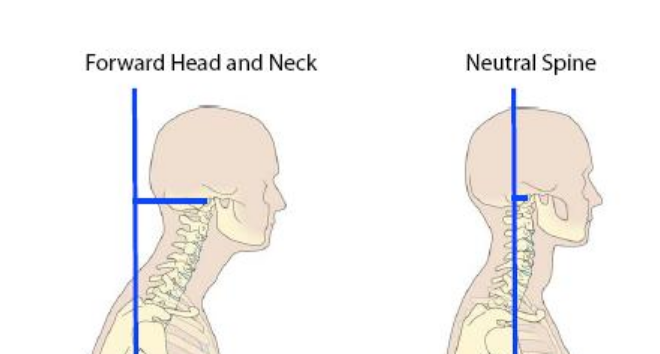
Your head is pretty heavy. It’s supposed to rest on your neck and shoulders like a golf ball on a tee. That’s its natural position. But in people with FHP, the head moves out forward of the shoulders, with the ears in line with the chest or front of the deltoids. Over time, this forward head position can lead to a tremendous amount of neck strain as well as the list of symptoms I mentioned above.
Common Causes of Forward Head Posture
I briefly mentioned some of the things that can lead to FHP above. But here are a few more that you should be aware of:
- Looking down while typing or reading
- Looking into a microscope
- Sitting improperly with rounded shoulders and a hunched back (for example, at a computer workstation)
- Driving with your head more than 2 to 3 inches away from the headrest
- Carrying a backpack or heavy purse slung over one shoulder
Repeated forward and/or downward facing postures cause concurrent hypotonic (lengthening) and hypertonic (shortening) of several major muscles in different areas of our upper body(rhomboid, trapezius, pectoral, suboccipital, etc.), degeneration of the vertebrae in the cervical spine, and irritation of cervical nerves.
According to the Mayo Clinic, FHP leads to “long-term muscle strain, disc herniation, arthritis, and pinched nerves.”
Pinched nerves, tightened shoulder and neck muscles, and postural imbalances all cause blood stagnation. And this leads to a toxic buildup in your system. Think of a pond in which the water isn’t moving and has become stagnant. The blockage of free-flowing water leads to stagnant water where nasty things grow. It works i much the same way in your body. If there’s a blockage or stagnation, there’s chronic pain.
4 Neck Exercises to Correct Forward Head Posture
When it comes to treating FHP, if you want the most pain relief possible, the goal is complete posture correction. Here are a few simple neck stretches and neck exercises to correct Forward Head Posture. And the best part is you can do them right at home.
Do them as directed, and you’ll be amazed how quickly you’ll go from someone with bad posture to someone with good posture who no longer suffers with chronic pain (or FHP!):
Lying Head Raise:
Lie face down on the floor, with your hands overlapped and held on your lower back. Lift and extend your head and shoulders up, while squeezing your shoulder blades together. Hold for three seconds, and repeat 15 times. Do this three times per day.
Chin Tuck:
Hold your shoulders straight in a neutral position. Stick your chin out to the front, hold for three seconds. Pull your chin in as far back as it will go, hold for three seconds. Repeat six times. Do this three times per day.
Chin to Chest Stretch:
Overlap your fingers and place both hands behind your head. Use your hands to push your head down so your chin goes toward your chest. Do NOT lower your head and then press with your hands, as this defeats the purpose of the stretch. Hold the stretch for 20 seconds and return to the upright position. You should feel a stretch between your shoulders. Repeat three times. Do this three times per day.
Doorway Stretch:
Stand with both feet parallel behind (but in the center of) a doorframe. Place one arm 90-degrees along the side of the doorframe facing you. If your right arm is touching the frame, then your right foot takes a long step forward. Be sure to bend your knee, as if you were really trying to walk forward. You should feel a nice stretch across your chest. If not, turn your body to the left. Hold for 20 seconds. Repeat three times then switch sides. Do this three times per day.
How to prevent Forward Head Posture
Here are a few simple ways to adjust your daily activities to prevent FHP from taking hold in your body—or from returning after balance is achieved:
- Make sure the top of your computer screen is level with your eyes and about two feet away from your face.
- Be sure to carry a backpack squarely over both shoulders to balance the weight distribution.
- If you carry a heavy purse or duffel bag, it is better to sling it diagonally across the torso.
- Have ample lower back support while sitting or lying down for prolonged periods, as a relaxed position leads to slouching and rounded shoulders, which can lead to FHP.
At this point, you should have a pretty good understanding of what causes Forward Head Posture and how to prevent it. You’ve also learned some great exercises to correct Forward Head Posture. For a complete resource that will help you understand how to fully treat FHP — or any other type of pack pain you may be experiencing — check out the Lose The Back Pain System.
With this cutting-edge system, you create your own Personalized Self Treatment Program – that helps target the specific type of back pain you’re experiencing right now.
It’s a powerful 3-part program consisting of DVD’s… audio CD’s… and an easy-to-read reference manual. And it’s GUARANTEED.
If you want to learn more about it – and eliminate your pain forever — just click this link.
Does the Lose the Back Pain program work? Watch this video…
Updated: September 9,2019